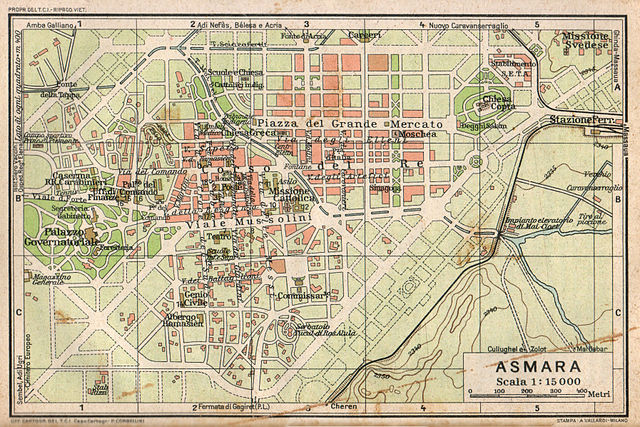
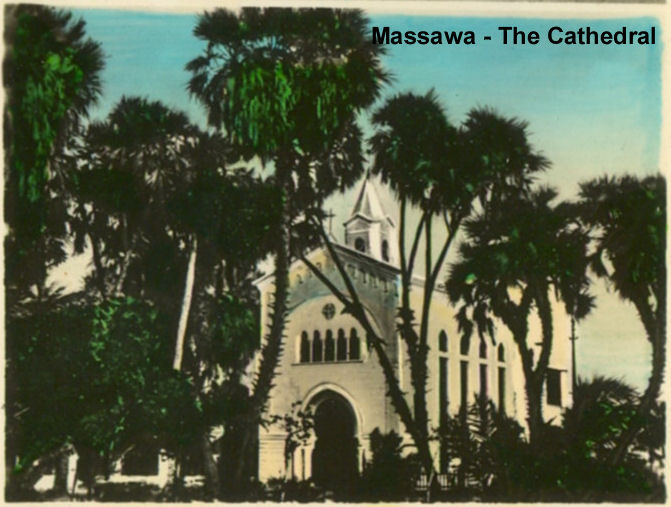
Italian Asmara is related to the decades of the colonial period when Eritrea's capital was ruled by the Italians. The city of Asmara came under Italian control in the 1880s after they conquered the territory of Italian Eritrea. In 1897, it was made the capital of the territory in substitution of Massaua: Asmara as a city was practically "created" by the Italians, when it was chosen as Eritrea's capital.
The Italians subsequently referred to the city as " Piccola Roma ", meaning "little Rome" in Italian language (1). This was due to the fact that the majority of its residents were Italians in the late 1930s: according to the Italian census of 1939, the city of Asmara had a population of 98000, of which 53000 were Italians. The following are videos and photos done by the Italian authorities in order to document the city, while under Italian rule: http://fondoluce.archivioluce.com/LuceUnesco/ricerca/libera/esito.html?luoghi=Asmara
Indeed in 1940 Asmara was a city where the majority of residents were Europeans and Catholics, with sections of the city that looked -as per people and architecture- like a typical southern European city. Since 2017 Asmara is in the UNESCO World Heritage List ( http://whc.unesco.org/en/list/1550 ).

History
.jpg)
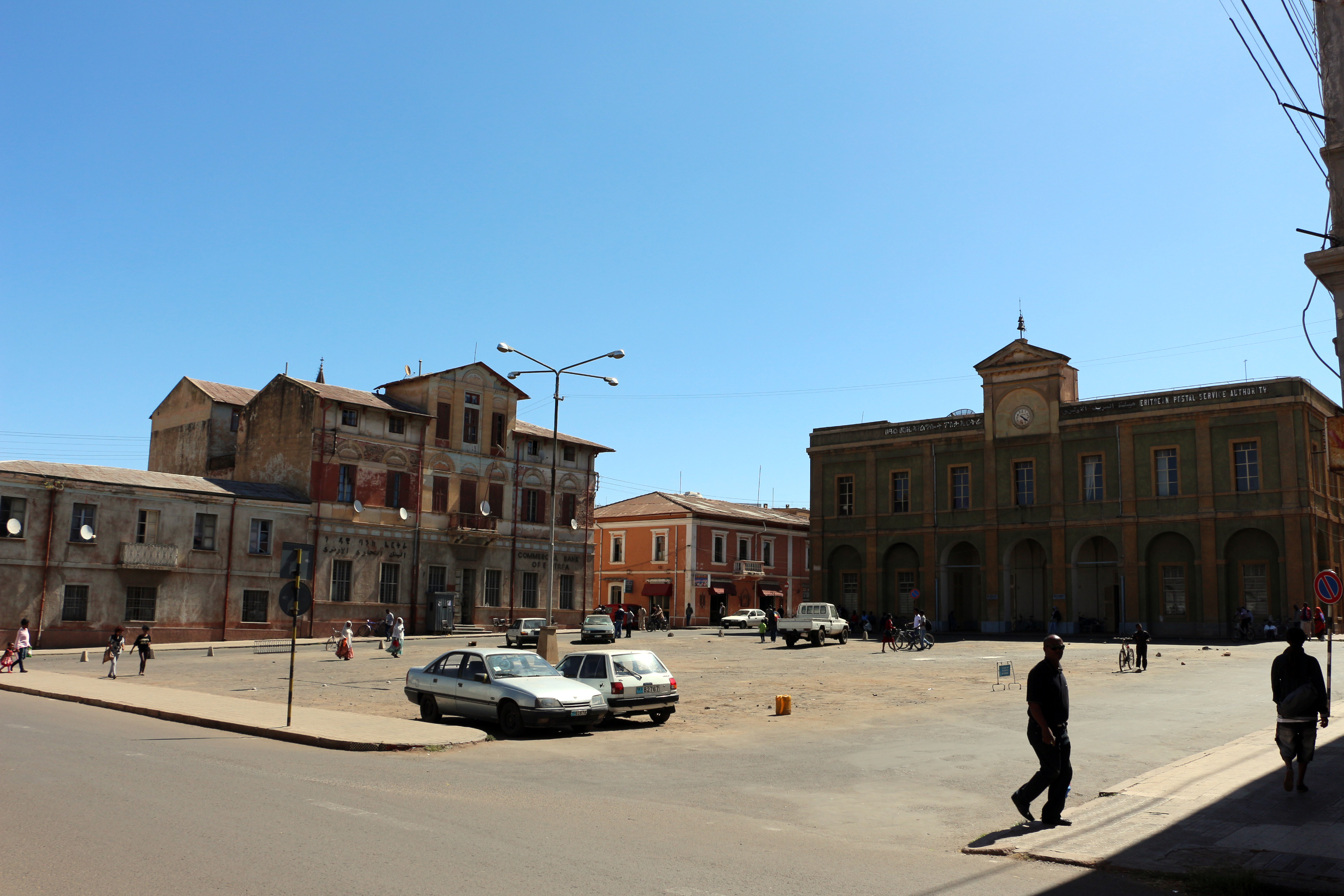
Indeed Asmara was populated in the 1930s by a large Italian community and consequently the city acquired an Italian architectural look.
According to the Italian census of 1939, the city of Asmara had a population of 98,000, of which 53,000 were Italian This fact made Asmara the main "Italian town" of the Italian empire in Africa. In all of Eritrea the population of Italians was only 75,000 in total in that year, making Asmara by far their largest centre (4).
Italian Asmara enjoyed a huge development in the 1930s, not only economically but even socially and culturally: Italians even created the beautiful theater Asmara's Opera and the car race "Circuito Asmara".
The official language was the Italian language, while the currency was the "Tallero Eritreo" until 1921 and later the "Italian East African lira". The city was mostly Christian, with Catholicism being the most numerous faith (64% in 1940, including the Italians): the government built in 1922 one of the best churches in Africa, the Asmara Roman Catholic Cathedral (called "St Joseph's Cathedral").
Asmara was connected to Addis Ababa (capital of Ethiopia) by the ''Via della Vittoria'', a fully asphalted new road of 1077 kms built between 1936 and 1939 and served by a weekly bus service that connected the two capitals in four days. A huge modern hospital (called "Hospitem, Ospedale italiano" (called now "Hospital Italiano" and still working with another Italian Hospital called "Hospital Regina Elena") was inaugurated in 1937.
The modern Asmara farm market ("Mercato Granaglie") was built in 1937 in neoclassical Italian fascism style

Asmara had one of the first airports in eastern Africa and was connected to Italy by the worldwide famous "Linea dell'Impero", an international flight of nearly 7,000 kms between Rome and Mogadiscio (capital of Italian Somalia).
This Asmara airport was created in 1922, the first such facility to be opened in Italian Eritrea. It served as the main military airport in the territory. In the mid-1930s, the airport began offering civilian and commercial flights: the first international was the Asmara-Rome, started in 1933.
Furthermore, an efficient postal service was created using the Asmara airport and efficiently linking the main Eritrean cities and villages.
On 7 July 1935, an agreement was signed with the British "Imperial Airways" to connect Asmara to Khartoum. A regular Kassala-Khartoum-Asmara-Massawa 770 km commercial route was subsequently started with a Caproni Ca.133 of the Italian "Ala Littoria".(read Flavio Riccitelli. ALA LITTORIA S.A. 1934–1941; and http://www.ilpostalista.it/unico2004pag55.htm ). During World War II, the airport was nearly destroyed by the British.
The first sport activities and structures were made in Italian Asmara in the early 1930s: it was even created a football tournament linked to the Italian championships.
Indeed the football in Eritrea was started during these colonial times and was concentrated in the capital region.The first championship (amateur) was in 1936 ( http://www.ilchichingiolo.it/cassetto34.htm ). the most important teams were "Gruppo Sportivo Cicero" (later GS Asmara), "Gruppo Rionale Neghelli", "GS Zuco", "GS Melotti", "GS Ferrovieri", "GS Marina' and the "GS Decamerè". In December 1936 the first six indigenous Eritrean teams started to compete in their own league (separate from the Italian league) and the best 3 native clubs (all having Italian names) were: "Ardita", "Savoia", "Vittoria" ( http://www.rsssf.com/tablese/erit36.html ).
The second championship was done in 1937 and was directly affiliated to the Italian Football Championship, as serie "D" or fourth level. It was divided in "Direttori" and Eritrea was the Direttorio XXIII Zona (Eritrea).The first football stadium was built in 1938 Asmara by the Italian businessman Francesco Cicero ( https://www.facebook.com/photo.php?fbid=2383918355166721&set=pcb.1440432222737184&type=3&theater&ifg=1 ) and since then it is called Cicero Stadium. It was later used by the GS Asmara, the team winner of the first professional football championships in Eritrea with the Asmara-born Luciano Vassalo.
Other sport were started in those years, like the bicycle race called "Bracciale Cona" (that later was the forerunner of the first "Tour of Eritrea" in 1946) and the tournaments of boxing and basketball.
 Intersection near Asmara of the cableway and the railway linking Asmara and Massaua
Many industrial investments (5) were made by Italy in Asmara and surrounding areas of Eritrea (more than 2100 factories existed in 1940), but the beginning of World War II stopped the blossoming industrialization of the area. Indeed Mussolini wanted to make Addis Abeba the capital and Asmara the main industrial/manufacturing center of his Africa Orientale Italiana (AOI) empire (a bit like Rome and Milan in Italy).
So, huge industries were created in the late 1930s in Asmara and in the outskirts (like Dek’emhare and Nefasit): most companies worked in the building sector, mechanics and metallurgy, foodstuffs and drinks, transports, chemicals and construction materials. The most famous companies created by "Asmarini" were the "Birra Melotti" and "Acqua Minerale Fenili", that were exported also to Italy.
However the symbol of Asmara's productive capacity in the 1940s was represented by the newborn "match" industry. The "A.M.A.P. - (AFRICAN MATCHES AND PAPER FACTORY LTD.) ASMARA - FABBRICA FIAMMIFERI" had created a great a 10,000 square meters plant, where 1,500 African workers worked, whose production daily was 300,000 boxes of matches, which -in addition to meeting domestic consumption and the one of the neighboring British colonies- were also exported to Britain. The chemical substances indispensable for the manufacture were obtained with the potassium salts of Dancalia.
New dancehalls, restaurants and bars were being opened everywhere. The working men’s clubs and numerous sports and recreational societies, supported by local government and by the PNF (fascist party), organised the colonists’ free time. In Eritrea, near the strategic hubs where companies and the army had located their logistic bases, new urban agglomerates rose from scratch, such as Dek’emhare and Nefasit in the distant outskirts of Asmara, with plenty of restaurants and clubs.

Afternoon strolling in Asmara's Viale Mussolini in spring 1940, just before WW2 started
Italy was defeated in 1941, and the British administered the city from then until 1952. Most Italians moved away from the city in those years, because after 1942 started a very difficult decade for the Italians of Asmara (see Eros Chiasserini. "Eritrea: Gli anni difficili (1941-1951)" http://www.maitacli.it/images/homepage/ERITREA%20-%20GLI%20ANNI%20DIFFICILI.pdf ): in 1952 the United Nations resolved to federate the former colony under Ethiopian rule, but only in 1991 Eritrea obtained the independence after a long struggle.
Indeed many Italian settlers got out of their A.O.I. colony after its full conquest by the "Allies" in November 1941 and they were reduced to only 38,000 by 1946. Although many of the remaining Italians stayed during the decolonization process after World War II and were actually assimilated into the Eritrean society, a few in Asmara were stateless in the 1980s, as none of them were given citizenship unless through marriage or, more rarely, by having it conferred upon them by the State. However in the 1990s all were given Italian passport and nearly all repatriated. In the last decades many of their descendants born in Asmara have moved to Italy, where they have taken the Italian citizenship (like Luciano Vassalo, a famous football player and trainer).
One of the most important members of the Italian community in Asmara was Dr. Vincenzo Di Meglio. In 1940 he promoted -with other Italian doctors- the creation in Asmara of a university section of a faculty of Medicine near the Hospital of Asmara (then called "Ospedale Italiano"): it was the first nucleus of the "University of Asmara" created in the 1950s. It was founded in 1941 and was called "Scuola italiana di Medicina di Asmara" (Sforza, M. 'La Scuola italiana di medicina di Asmara.Rievocazione di un'opera di italianità (1941 – 1961)'. Tipografia Arcuri. Roma, 1978). During the last years of World War II Dr. Di Meglio defended politically the Italians of Eritrea and successively promoted the independence of Eritrea. After the war he supported the creation of the ''Associazione Italo-Eritrei'' and the ''Associazione Veterani Ascari'', in order to get alliance with the Eritreans favorable to Italy in Eritrea. As a result of these creations, he cofounded the ''Partito Eritrea Pro Italia'' ("Party of Shara Italy") in September 1947, an Eritrean political Party favorable to the Italian presence in Eritrea that obtained more than 200,000 inscriptions of membership in one single month.
Indeed the Italian Eritreans strongly rejected the Ethiopian annexation of Eritrea after the war: the "Party of Shara Italy" was established in Asmara and Eritrea in the late 1940s and the majority of the members were former Italian soldiers with many Eritrean Ascari (the organization was even backed up by the government of Italy).
Today there are approximately 900 Italian Eritreans remaining in the Asmara metropolitan region. However, there are an estimated 100,000 descendants of Italian Eritreans out of the 600,000 population of the city of Asmara.
So, huge industries were created in the late 1930s in Asmara and in the outskirts (like Dek’emhare and Nefasit): most companies worked in the building sector, mechanics and metallurgy, foodstuffs and drinks, transports, chemicals and construction materials. The most famous companies created by "Asmarini" were the "Birra Melotti" and "Acqua Minerale Fenili", that were exported also to Italy.
However the symbol of Asmara's productive capacity in the 1940s was represented by the newborn "match" industry. The "A.M.A.P. - (AFRICAN MATCHES AND PAPER FACTORY LTD.) ASMARA - FABBRICA FIAMMIFERI" had created a great a 10,000 square meters plant, where 1,500 African workers worked, whose production daily was 300,000 boxes of matches, which -in addition to meeting domestic consumption and the one of the neighboring British colonies- were also exported to Britain. The chemical substances indispensable for the manufacture were obtained with the potassium salts of Dancalia.
New dancehalls, restaurants and bars were being opened everywhere. The working men’s clubs and numerous sports and recreational societies, supported by local government and by the PNF (fascist party), organised the colonists’ free time. In Eritrea, near the strategic hubs where companies and the army had located their logistic bases, new urban agglomerates rose from scratch, such as Dek’emhare and Nefasit in the distant outskirts of Asmara, with plenty of restaurants and clubs.
In Asmara there were the following cinemas in early 1940, before the start of the war:
1) Cinema Augustus (2002 seats)
2) Teatro Asmara (890 seats)
3) Cinema Impero (1950 seats)
4) Cinema Odeon (1874 seats)
5) Cinema Roma (1500 seats)
6) Cinema Santa Caterina of the Catholic Mission (300 seats)
7) Cinema Dante (580 seats)
8) Cinema Hamasien (850 seats)
Afternoon strolling in Asmara's Viale Mussolini in spring 1940, just before WW2 started
Italy was defeated in 1941, and the British administered the city from then until 1952. Most Italians moved away from the city in those years, because after 1942 started a very difficult decade for the Italians of Asmara (see Eros Chiasserini. "Eritrea: Gli anni difficili (1941-1951)" http://www.maitacli.it/images/homepage/ERITREA%20-%20GLI%20ANNI%20DIFFICILI.pdf ): in 1952 the United Nations resolved to federate the former colony under Ethiopian rule, but only in 1991 Eritrea obtained the independence after a long struggle.
Indeed many Italian settlers got out of their A.O.I. colony after its full conquest by the "Allies" in November 1941 and they were reduced to only 38,000 by 1946. Although many of the remaining Italians stayed during the decolonization process after World War II and were actually assimilated into the Eritrean society, a few in Asmara were stateless in the 1980s, as none of them were given citizenship unless through marriage or, more rarely, by having it conferred upon them by the State. However in the 1990s all were given Italian passport and nearly all repatriated. In the last decades many of their descendants born in Asmara have moved to Italy, where they have taken the Italian citizenship (like Luciano Vassalo, a famous football player and trainer).
One of the most important members of the Italian community in Asmara was Dr. Vincenzo Di Meglio. In 1940 he promoted -with other Italian doctors- the creation in Asmara of a university section of a faculty of Medicine near the Hospital of Asmara (then called "Ospedale Italiano"): it was the first nucleus of the "University of Asmara" created in the 1950s. It was founded in 1941 and was called "Scuola italiana di Medicina di Asmara" (Sforza, M. 'La Scuola italiana di medicina di Asmara.Rievocazione di un'opera di italianità (1941 – 1961)'. Tipografia Arcuri. Roma, 1978). During the last years of World War II Dr. Di Meglio defended politically the Italians of Eritrea and successively promoted the independence of Eritrea. After the war he supported the creation of the ''Associazione Italo-Eritrei'' and the ''Associazione Veterani Ascari'', in order to get alliance with the Eritreans favorable to Italy in Eritrea. As a result of these creations, he cofounded the ''Partito Eritrea Pro Italia'' ("Party of Shara Italy") in September 1947, an Eritrean political Party favorable to the Italian presence in Eritrea that obtained more than 200,000 inscriptions of membership in one single month.
Indeed the Italian Eritreans strongly rejected the Ethiopian annexation of Eritrea after the war: the "Party of Shara Italy" was established in Asmara and Eritrea in the late 1940s and the majority of the members were former Italian soldiers with many Eritrean Ascari (the organization was even backed up by the government of Italy).
Today there are approximately 900 Italian Eritreans remaining in the Asmara metropolitan region. However, there are an estimated 100,000 descendants of Italian Eritreans out of the 600,000 population of the city of Asmara.
Italian architecture
Italian Asmara represents one of the most concentrated and intact assemblage of "Modernist architecture" anywhere in the world. The urban design within the "Historic Perimeter" of modern Asmara has remained untouched since its original implementation and subsequent evolution in the 1930s, and the architectural elements exemplifies a superlative example of Modernist architecture in a complete urban setting.(6)
The city's architecture is heavily influenced by Italian architecture, even since 1914, the Italians created urban plans for Asmara. The best plan was done in 1937 by Cafiero:
Vittorio Cafiero in 1937 did a new "Urban Plan" for Asmara ... maintaining the old street plans -done by the "Cavagnari Plan" in 1914- that divided Asmara in four sections: the Italian, the native Eritrean, the governmental and the industrial. He added a new section for future development with a "circular circle avenue". The improvement of the axis around "Rome square", "Mussolini boulevard", "Cadorna boulevard" and the "railways station", moved to the south the administrative/economic center of the planned city ...to the southeast there was the green quarter with rich villas around the Gamma Band "hill ... and to the north of the 'Milano boulevard' there was the indigenous quarter. Santoianni; Progettazione_Architettonica
In 1885, the Italians invaded Eritrea and by 1900 Asmara had become the capital city: the site was chosen mainly for its salubrious highland climate, reliable water supply and ideal geographic location in the center of Eritrea.

The "President's Office" in Asmara, built in 1897
In the early twentieth century, Asmara was a small city/village that grew to become a well-established town by the 1920s.
However, by the 1930s, it was clear that Italy, under the rule of Benito Mussolini, was intent on invading Ethiopia and would use Eritrea as the launch pad for this long-held ambition. In preparation for this substantial military attack, an unprecedented quantity of materials and labor flowed into Eritrea throughout the 1930s. In a matter of months, Asmara became a vast building site, as over 70,000 Italians arrived to established new lives for themselves.
The rapid transformation of Asmara, from a small town into Africa's most modern and sophisticated city, involved the global proliferation of "Modernism" and its various forms, including "Futurism", "Rationalism,"Novecento Italiano", and "Art Deco": the spirit of this new world of ideas and of the new forms of architecture was present in Asmara transformation and evolution to become a typical Italian city.
From 1935-1941, thousands of buildings were constructed in the city, most of which reflect various Modernist styles and some of which represent inimitable architectural forms, such as petroleum stations mimicking aeroplanes and boats, commercial buildings designed as trains, cavernous cinemas with fine period plasterwork and Art Deco interiors, fine ultra-modern hotels and offices, and government buildings with highly politicized monumental designs.
Features

The Cinema Impero was constructed in Asmara in 1937. It is a famous example of the Art Deco style

"Italian Governor's Palace", now City Hall of Asmara

"Fiat Tagliero Building", a worldwide famous masterpiece of Art Deco architecture.
The city is known for its early 20th century buildings, including the Art Deco "Cinema Impero" (opened in 1937 and considered by the experts one of the world's finest examples of Art Déco style building), the Cubist "Africa Pension", the rationalist "Governor's Palace", the eclectic Eritrean Orthodox "Tewahdo" Church, the former "Asmara Opera House", the futurist architecture "Fiat Tagliero Building", the neo-Romanesque architecture "Roman Catholic Cathedral", and the neoclassical architecture "Presicent's Palace". The city is adorned by Italian colonial villas and mansions, one prominent example being the "Asmara's World Bank Building".
Most of central Asmara was built between 1935 and 1941, so effectively the Italians managed to build almost an entire city in just six short years. (6)
At this time, the dictator Benito Mussolini had great plans for a second Roman Empire in Africa. War cut this short, but his injection of funds created the Asmara of today, which supposedly was to be a symbol that his "Fascism" worked and that it was an ideal system of government.
The city shows off most early 20th century architectural styles. Some buildings are "neo-Romanesque architecture", such as the Roman Catholic Cathedral, some villas are built in a late "Victorian Architecture" style. Art Deco influences are found throughout the city; essentially Asmara was then what Dubai is now.
Architects were restricted by nothing more than the bounds of their imaginations and were given the funds to create masterpieces which we can see today. Essences of "Cubism" can be found on the "Africa Pension Building", and on a small collection of buildings. The "Fiat Tagliero Building" shows almost the height of futurism, just as it was coming into big fashion in Italy. In recent times, some buildings have been functionally built which sometimes can spoil the atmosphere of some cities, but they fit into Asmara as it is such a modern city.
Italian Asmara was known in 1940 to be an exceptionally modern city, not only because of its architecture, but even because had more "traffic lights" than Rome had when the city was being built. The city incorporates many features of a planned city. Indeed, Asmara was an early example of an ideal modern city created by architects, an idea which was introduced into many cities across the world, such as Brasilia, but which was not altogether popular. Features include designated city zoning and planning, wide treed boulevards, political areas and districts and space and scope for development.
_Piazza_Roma_e_Palazzo_Banca_d'Italia.jpg) The Bank of Italy building in 1938, facing the "Piazza Roma" fountain.
The Bank of Italy building in 1938, facing the "Piazza Roma" fountain.
The city has been regarded as "New Rome" or "Italy's African City" due to its quintessential Italian touch, not only for the architecture, but also for the wide streets, piazzas and coffee bars. While the boulevards are lined with palms and indigenous shiba'kha trees, there are numerable pizzerias and coffee bars, serving "cappuccinos" and "lattes", as well as "ice cream" parlours.
Indeed the first brewery in Asmara (and Eritrea) was the Melotti Brewery, that was founded in 1939 by Luigi Melotti: even now it exists but with the new name "Asmara Brewery" and supports one of the best football teams in Eritrea (the "Asmara Brewery F.C.").
Asmara is a new addition (since July 2017) to the UNESCO's World Heritage Sites, under the direction of the "Cultural Assets Rehabilitation Project", for its outstanding examples of 20th century architecture and town planning when was called Asmara italiana ( see gallery photos: http://whc.unesco.org/en/list/1550/gallery/ )
Asmara, a village that became the capital in 1891, still conserves an almost intact urban structure and architectural features from its half century of colonialism. The first expansion of Asmara was regulated by a scheme plan, approved in 1902, which included the area to the East of the original military outpost on the Mai Belà river. The grid pattern was marked by two major arteries, parallel to each other: the King’s Way (il Corso del Re) and the Queen’s Avenue (il Viale della Regina). After the space of a decade, Cavagnari’s plan was the first to separate the European settlement from the indigenous zone. The advent of Fascism did not have an immediate impact in Eritrea; by then the capital had developed a well-integrated population. One is continuously surprised by testimonies of the residents in Asmara in the Thirties, which express a state of mind shared by both colonizers and colonized, describing the city as: ‘beautiful [...] inhabited by a mixed race, Italians and Africans ... a lot of traffic, shops, cinemas and restaurants...’ . It is commonplace to refer to ‘good Italian people’ (italiani brava gente), which is a most difficult viewpoint to abandon, and is also a most relevant perspective when considering the architectural patrimony of Asmara as a shared heritage.M. Casciato, University of Bologna(7)
Education in Italian Asmara

After the 1923 "Riforma Gentile" in Asmara were created 3 high schools: the "Liceo Martini", the "Istituto Tecnico Bottego", and in the late 1930s the "Istituto Magistrale". The highest-level institution was the Italian Lyceum "Ferdinando Martini" in Eritrea's capital, that was founded in 1926 and in 1935 was named "Liceo Scientifico" (while in 1937 the name was changed to "Liceo Classico") with nearly all the students coming from the Italian community of Asmara: it was returned to be a scientific Lyceum only in 1956, when nearly half of the students were Eritreans.
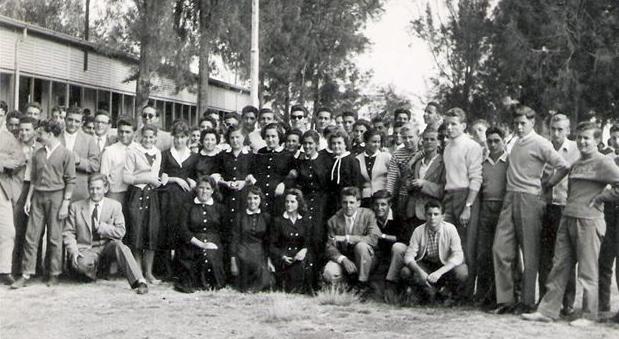
Italian students of a high school in 1940 Asmara
Institutions-Cine/Theaters-Media

Asmara, a postcolonial "living fossil" capital
scuole per italiani
• Scuola elementare mista Principe di Piemonte • Scuola elementa-
re mista (a Gaggiret) • Scuola elementare mista (ad Amba Galliano)
• Ginnasio-Liceo Ferdinando Martini • Istituto tecnico-commerciale e
per geometri Vittorio Botteg
o • Istituto magistrale • Missione cattoli-
ca asilo d’infanzia e scuola elementare parificata mista
scuole per africani
• Scuole eritree Vittorio Emanuele III • Scuola elementare Carlo Sca-
lera (ad Acria
)
•
Missione cattolica scuola parificata
istituzioni e associazioni
• Sopraintendenza scolastica • Patronato scolastico • Biblioteca del
governo • Istituto siero-vaccinogeno • Ufficio agrario • Scuola di me-
dicina presso l’ospedale di Asmara (1941) • Ufficio topo-cartografico
del comando truppe dell’Eritrea (missione dell’Istituto geografico milita-
re
)
•
Società Dante Alighier
i
• Regio automobile club d’Italia • Con-
sociazione turistica italiana • Compagnia italiana turismo • Casa del
fascio Arnaldo Mussolini • Istituto di cultura fascista • Gruppo uni-
versitario fascist
a • Casa dell’operaio dell’Opera nazionale dopolavo-
r
o
•
Casa della Gioventù italiana del littorio (sede dell’Ufficio stampa e
propaganda dell’Eritrea
)
• Circolo ufficiali • Circolo cattolico • As-
sociazione tennistica
cinema, teatri, radio, istituto luce
• Teatro di Asmara • Teatro Santa Cecilia (missione cattolica) • Ci-
nema teatro Ciaao (Compagnia immobiliare alberghi Africa orientale)
• Cinema Excelsior • Cinema Umberto • Cinema Dante • Cinema
Impero • Cinema Odeon • Stazione radiofonica Eiar (con audito-
rio
)
• Istituto Luce
pubblicazioni
• «Bollettino ufficiale del Governo dell’Eritrea»
(quindicinale)
• «Fo-
glio d’ordini e di comunicazioni del Governo dell’Eritrea»
(quindici-
nale)
• «Bollettino economico dell’Eritrea»
(mensile)
• «Corriere
Eritreo»
(quotidiano della Federazione dei fasci di combattimento dal
3 novembre 1936. Fino al 9 maggio 1936 «La Nuova Eritrea», dal 10
maggio al 2 novembre 1936 «Corriere dell’Impero»)
• «Corriere Eri-
treo Sportivo»
(settimanale del lunedì del «Corriere Eritreo»)
• «Pa-
gina del GUF»
(inserto periodico del «Corriere Eritreo»)
• «Parole
Buone»
(mensile della missione cattolica)
editori:
• Stamperia del governo • Tipografia francescana
scuole per italiani
• Scuola elementare mista Principe di Piemonte • Scuola elementa-
re mista (a Gaggiret) • Scuola elementare mista (ad Amba Galliano)
• Ginnasio-Liceo Ferdinando Martini • Istituto tecnico-commerciale e
per geometri Vittorio Botteg
o • Istituto magistrale • Missione cattoli-
ca asilo d’infanzia e scuola elementare parificata mista
scuole per africani
• Scuole eritree Vittorio Emanuele III • Scuola elementare Carlo Sca-
lera (ad Acria
)
•
Missione cattolica scuola parificata
istituzioni e associazioni
• Sopraintendenza scolastica • Patronato scolastico • Biblioteca del
governo • Istituto siero-vaccinogeno • Ufficio agrario • Scuola di me-
dicina presso l’ospedale di Asmara (1941) • Ufficio topo-cartografico
del comando truppe dell’Eritrea (missione dell’Istituto geografico milita-
re
)
•
Società Dante Alighier
i
• Regio automobile club d’Italia • Con-
sociazione turistica italiana • Compagnia italiana turismo • Casa del
fascio Arnaldo Mussolini • Istituto di cultura fascista • Gruppo uni-
versitario fascist
a • Casa dell’operaio dell’Opera nazionale dopolavo-
r
o
•
Casa della Gioventù italiana del littorio (sede dell’Ufficio stampa e
propaganda dell’Eritrea
)
• Circolo ufficiali • Circolo cattolico • As-
sociazione tennistica
cinema, teatri, radio, istituto luce
• Teatro di Asmara • Teatro Santa Cecilia (missione cattolica) • Ci-
nema teatro Ciaao (Compagnia immobiliare alberghi Africa orientale)
• Cinema Excelsior • Cinema Umberto • Cinema Dante • Cinema
Impero • Cinema Odeon • Stazione radiofonica Eiar (con audito-
rio
)
• Istituto Luce
pubblicazioni
• «Bollettino ufficiale del Governo dell’Eritrea»
(quindicinale)
• «Fo-
glio d’ordini e di comunicazioni del Governo dell’Eritrea»
(quindici-
nale)
• «Bollettino economico dell’Eritrea»
(mensile)
• «Corriere
Eritreo»
(quotidiano della Federazione dei fasci di combattimento dal
3 novembre 1936. Fino al 9 maggio 1936 «La Nuova Eritrea», dal 10
maggio al 2 novembre 1936 «Corriere dell’Impero»)
• «Corriere Eri-
treo Sportivo»
(settimanale del lunedì del «Corriere Eritreo»)
• «Pa-
gina del GUF»
(inserto periodico del «Corriere Eritreo»)
• «Parole
Buone»
(mensile della missione cattolica)
editori:
• Stamperia del governo • Tipografia francescana
scuole per italiani
• Scuola elementare mista Principe di Piemonte • Scuola elementa-
re mista (a Gaggiret) • Scuola elementare mista (ad Amba Galliano)
• G
per
o • Istituto magistrale • Missione cattoli-
ca asilo d’infanzia e scuola elementare parificata mista
scuole per africani
• Scuole eritree Vittorio Emanuele III • Scuola elementare Carlo Sca-
lera (ad Acria
)
•
Missione cattolica scuola parificata
istituzioni e associazioni
• Sopraintendenza scolastica • Patronato scolastico • Biblioteca del
governo • Istituto siero-vaccinogeno • Ufficio agrario • Scuola di me-
dicina presso l’ospedale di Asmara (1941) • Ufficio topo-cartografico
ndo truppe dell’Eritrea (missione dell’Istituto geografico milita-
re
)
•
Società Dante Alighier
i
• Regio automobile club d’Italia • Con-
sociazione turistica italiana • Compagnia italiana turismo • Casa del
fascio Arnaldo Mussolini • Istituto di cultura fascista • Gruppo uni-
versitario fascist
a • Casa dell’operaio dell’Opera nazionale dopolavo-
r
o
•
Casa della Gioventù italiana del littorio (sede dell’Ufficio stampa e
propaganda dell’Eritrea
)
• Circolo ufficiali • Circolo cattolico • As-
sociazione tennistica
cinema, teatri, radio, istituto luce
• Teatro di Asmara • Teatro Santa Cecilia (missione cattolica) • Ci-
nema teatro Ciaao (Compagnia immobiliare alberghi Africa orientale)
• Cinema Excelsior • Cinema Umberto • Cinema Dante • Cinema
Impero • Cinema Odeon • Stazione radiofonica Eiar (con audito-
rio
)
• Istituto Luce
pubblicazioni
• «Bollettino ufficiale del Governo dell’Eritrea»
(quindicinale)
• «Fo-
glio d’ordini e di comunicazioni del Governo dell’Eritrea»
(quindici-
nale)
• «Bollettino economico dell’Eritrea»
(mensile)
• «Corriere
Eritreo»
(quotidiano della Federazione dei fasci di combattimento dal
3 novembre 1936. Fino al 9 maggio 1936 «La Nuova Eritrea», dal 10
maggio al 2 novembre 1936 «Corriere dell’Impero»)
• «Corriere Eri-
treo Sportivo»
(settimanale del lunedì del «Corriere Eritreo»)
• «Pa-
gina del GUF»
(inserto periodico del «Corriere Eritreo»)
• «Parole
Buone»
(mensile della missione cattolica)
editori:
• Stamperia del governo • Tipografia francescana
scuole per italiani
• Scuola elementare mista Principe di Piemonte • Scuola elementa-
re mista (a Gaggiret) • Scuola elementare mista (ad Amba Galliano)
Casa del
fascio Arnaldo Mussolini • Istituto di cultura fascista • Gruppo uni-
versitario fascist
a • Casa dell’operaio dell’Opera nazionale dopolavo-
r
o
•
Casa della Gioventù italiana del littorio (sede dell’Ufficio stampa e
propaganda dell’Eritrea
)
• Circolo ufficiali • Circolo cattolico • As-
sociazione tennistica
cinema, teatri, radio, istituto luce
• Teatro di Asmara • Teatro Santa Cecilia (missione cattolica) • Ci-
nema teatro Ciaao (Compagnia immobiliare alberghi Africa orientale)
• Cinema Excelsior • Cinema Umberto • Cinema Dante • Cinema
Impero • Cinema Odeon • Stazione radiofonica Eiar (con audito-
rio
)
• Istituto Luce
pubblicazioni
• «Bollettino ufficiale del Governo dell’Eritrea»
(quindicinale)
• «Fo-
glio d’ordini e di comunicazioni del Governo dell’Eritrea»
(quindici-
nale)
• «Bollettino economico dell’Eritrea»
(mensile)
• «Corriere
Eritreo»
(quotidiano della Federazione dei fasci di combattimento dal
3 novembre 1936. Fino al 9 maggio 1936 «La Nuova Eritrea», dal 10
maggio al 2 novembre 1936 «Corriere dell’Impero»)
• «Corriere Eri-
NOTES
Notes
- ^ Italian Asmara
- ^ Ambraseys, Nicolas; Melville, C.P.; Adams, R.D. (1994). The Seismicity of Egypt, Arabia and the Red Sea: A Historical Review. Cambridge University Press. ISBN 0-521-39120-2.
- ^ Italian architectural planification of Asmara (in Italian) p. 64-66
- ^ "Benvenuto sul sito del Maitacli" (in Italian). Archived from the original on 22 July 2011. Retrieved 8 July 2011.
- ^ Italian Eritrea industries
- ^ BBC: Reviving Asmara; [1]
- ^ "Da campo militare a capitale: Asmara colonia italiana e oltre"
Links
* http://fondoluce.archivioluce.com/LuceUnesco/libera/scheda/video/IL5000026738/2/Impero-Italiano-Asmara.html?descrizione=asmara&temi=Opere%20pubbliche%20del%20fascismo Video of "Asmara italiana"* http://www.mediacomunitaeritrea.it/eritrea-2/nggallery/page/1 Gallery of photos of Italian Asmara (click slideshow)
* "Atlante delle colonie italiane". Detailed Atlas of Italian colonies, written by Baratta Mario and Visintin Luigi in 1928 (in Italian)
* http://www.trainweb.org/eritrean/scrapbook/when/running/italian_east_africa.html Eritrean railways (Guida dell'Africa Orientale Italiana)
* https://www.youtube.com/watch?v=pSDZIYoBjwk Video of actual Asmara, showing many Italian era buildings
* https://cloudfront.escholarship.org/dist/prd/content/qt4mb1z7f8/qt4mb1z7f8.pdf "Colonial Inertia and Postcolonial Capital in Asmara", by Mia Fuller (University of California)

.jpg)
.jpg)
.jpg)
.jpg)