Indeed in less than three years (1938/1940) -after the arrival of the Viceroy Amedeo D'Aosta and the first successes against the Ethiopian guerrilla with the complete "pacification" of the region (called "Scioa" and sometimes "Shewa") around Addis Abeba- there was a rapid increase in public works, the construction of an extensive road network with six thousand kilometers of paved roads, a visible improvement of agriculture and veterinary services, the construction of clinics and (previously non-existent) health care places located every thirty kilometers, an appreciable spread of education and various forms of assistance and a generalized development of Italian entrepreneurship and work.

The Ansaldo Corporation of Italy in 1935 created a one-kilowatt station in the outskirts of Addis Abeba, inaugurated with a speech of emperor Selassie. The Italians took over the station in early 1936 and planned to develop it into a communications center for their new empire, joining those already established in Somalia and in Asmara (Radio Marina). A more powerful radio station of seven kilowatts was started by the Italians in 1937 (broadcasting the first radio-programs of Ethiopia, as can be seen in the above photo).
The Bank of Italy issued the loan "City of Addis Ababa" for 200 million lire, and in the spring of 1940 the city appeared to be a huge construction site. When Italy entered the war, the attack on British Somalia in the summer of 1940 and the British counter-offensive in early 1941 blocked all the works of Addis Ababa. The news of the construction of the new capital disappeared from the Italian press, as nearly all the traces of the Italian occupation were later canceled from the current city.
Aerial view of the Addis Abeba' center in the urban masterplan of 1939 Italian Ethiopia:

It is noteworthy to pinpoint that in 1940 there was a satisfactory management -by the Italian government- of relations with different religious cults and that in Addis Abeba (and Ethiopia) there was the construction of churches and mosques without problems.
BRIEF HISTORY
Addis Abeba grew from 45,000 inhabitants in spring 1936 (when the Italians won the Italo-Ethiopian war) to nearly 150,000 in spring 1941, when the Italians were defeated and the Allies (with emperor Selassie) returned to the city.
The city, that looked in 1935 like a medieval town (also because of thousands of slaves living in dire conditions) in just five years was transformed in a modern capital where more than 40,000 Italians lived in a city with a typical XX century society, free of slavery and full of developments & improvements.
Indeed during Italian rule, the Italians abolished slavery in all Ethiopia, issuing two laws in October 1935 and in April 1936 by which they declared to have freed 420,000 people. After Italian defeat in Second World War, Emperor Haile Selassie, who returned to power, abandoned his previous ideas about a slow and gradual abolition of slavery in favor of one that mirrored Italy’s civilized abrogation ( https://blogs.loc.gov/law/2012/02/abolition-of-slavery-in-ethiopia/)

The british Lady Kathleen Simon of the "Anti-Slavery Protection Society" was one of the first to appreciate this action and the definitive end of slavery in Ethiopia.
The capital of the empire was due to become, in Mussolini’s opinion, the most beautiful and futuristic city in Africa, the beacon of the new fascist civilization. The preparation of the new town planning scheme was very long and problematic, involving top professional people like Giò Ponti, Enrico Del Debbio, Giuseppe Vaccaro and even Le Corbusier, who personally asked Mussolini to be allowed to design the plan for the new city (https://failedarchitecture.com/le-corbusiers-visions-for-fascist-addis-ababa/).
However the city in May 1936 had no major infrastructures: there was no electricity in many areas, there were no sewers at all, only a few roads were asphalted and the city lacked a road network connecting with other Ethiopian urban centers. But there was an aqueduct in operation, which supplied only some areas, while fast transport was provided only by the Gibuti-Addis Ababa railway line, built by the French and inaugurated in 1917. The Italians solved all these infrastructure problems in a few years of hard work!
The famous "Villa Italia" in the outskirts of the city was improved in late 1936, as a residence of the main Italian authorities ( https://baldi.diplomacy.edu/diplo/texts/Del_Papa_VillaItalia.pdf ).
In autumn 1937, the result of the initial works managed by the Governorate of Addis Ababa in a year and a half of activity was, all in all, positive: the repaving of the main roads, the restoration of existing health facilities, the expansion of some hotels and the restructuring of the natives market. Moreover six buildings of the I.N.C.I.S ( housing institution for government employees) were built. And also the "Casa del Fascio", both inaugurated on 28 October; while the Regulatory Plan Office had expropriated property in the industrial zone and some areas had been given in concession to institutions and private individuals (Video of initial Italian constructions in 1936 Addis Abeba: https://www.youtube.com/watch?v=Vl62UoJbr_s )
However the city in May 1936 had no major infrastructures: there was no electricity in many areas, there were no sewers at all, only a few roads were asphalted and the city lacked a road network connecting with other Ethiopian urban centers. But there was an aqueduct in operation, which supplied only some areas, while fast transport was provided only by the Gibuti-Addis Ababa railway line, built by the French and inaugurated in 1917. The Italians solved all these infrastructure problems in a few years of hard work!
The famous "Villa Italia" in the outskirts of the city was improved in late 1936, as a residence of the main Italian authorities ( https://baldi.diplomacy.edu/diplo/texts/Del_Papa_VillaItalia.pdf ).
In autumn 1937, the result of the initial works managed by the Governorate of Addis Ababa in a year and a half of activity was, all in all, positive: the repaving of the main roads, the restoration of existing health facilities, the expansion of some hotels and the restructuring of the natives market. Moreover six buildings of the I.N.C.I.S ( housing institution for government employees) were built. And also the "Casa del Fascio", both inaugurated on 28 October; while the Regulatory Plan Office had expropriated property in the industrial zone and some areas had been given in concession to institutions and private individuals (Video of initial Italian constructions in 1936 Addis Abeba: https://www.youtube.com/watch?v=Vl62UoJbr_s )
However work started on a full scale only in 1939. The fourth and last definitive Addis Abeba urban plan -approved by Mussolini in late 1938- provided for a clear separation between the European and indigenous areas. This would have meant transferring the African population and building tens of thousands of new homes.

Map showing the definitive Urban Plan for Addis Abeba, approved by Mussolini in 1938 with the "green" separation of the native southern quarters (in brown color) from the Italian northern quarters (in white, to be built)
Italian settlers had increased from a few thousands in early 1937 (with 150 families) to over 40,000 in March 1940 (33,059 men, 6,998 women and about 4,000 families) whilst the African population had practically doubled and was estimated at about 100,000 people.
The Health Corps of Italian Africa was created only in 1936, and it was made up of about 200 doctors and health inspectors, by organising a special public competition which took place between 1937 and 1938. Three centres were gradually built in Addis Ababa, Asmara and Mogadishu, specialised in the cure of malaria, as well as numerous hospitals and clinics. Following direct orders by Mussolini, since 1936 special attention was naturally given to the prevention and cure of venereal diseases (since the authorities could not prevent contact between Italian men and African women), by rounding up and imposing forced hospitalisation on thousand of native women in special “syphilis homes”.
As a consequence towards the end of 1938 the incidence of sexual diseases had dropped: the percentage of Italian soldiers suffering from venereal diseases was about 5 % compared to 10 % in 1937, whilst that of civilians, which was much lower, had decreased from 1.4 to 0.9 %. An improvement was also registered among indigenous military personnel, from 3.7 % to 2 %.
These data of course reinforced Mussolini’s will to increase the number of whole families emigrating from Italy to AOI. A remarkable effort was made to improve healthcare: beside the doctors belonging to the Italian Africa Health Corps, flanked by 450 military doctors, there were about 500 civilian doctors (232 specialists, among whom 30 paediatricians, and 262 general practicioners). Special maternity wards were built in the hospitals situated in the main locations.

The new Italian hospital in Addis Ababa had a delivery room and a pediatric clinic for Italians, with a capacity of over 100 beds in its various sections: expectant mothers, postpartum mothers, babies’ room, gynaecological ward, infectious diseases, visitors’ room, etc. The children’s hospital was subdivided into separate wards for babies and older children, for infectious, gastro-intestinal or pulmonary diseases, etc. Moreover, a university-type faculty was founded in early 1940 in Asmara to train nurses and the same was planned for Addis Abeba.

The new Italian hospital in Addis Ababa had a delivery room and a pediatric clinic for Italians, with a capacity of over 100 beds in its various sections: expectant mothers, postpartum mothers, babies’ room, gynaecological ward, infectious diseases, visitors’ room, etc. The children’s hospital was subdivided into separate wards for babies and older children, for infectious, gastro-intestinal or pulmonary diseases, etc. Moreover, a university-type faculty was founded in early 1940 in Asmara to train nurses and the same was planned for Addis Abeba.
In Addis Ababa the number of new-born Italian babies was continually growing, rising from 50 in 1937 to 570 in 1939 and the number of weddings being celebrated shot up too, despite the dramatic housing shortage. Italians lived in all possible ways: many continued to live in temporary shelters (tents, huts and prefabricated houses), whilst a lot of families used indigenous homes that had been expropriated or rented.
Mussolini found this situation intolerable, and he constantly urged the Italian East Africa’s government to ensure a more vigorous policy of racial separation (on his orders the African market had been forbidden to Europeans, but the measure was later withdrawn, because indigenous trade was indispensable for the provision of food by whites).
As Amedeo d’Aosta (the new Viceroy of AOI since 1938) once remarked, the solution of the problem of racial prestige was incompatible with the housing situation: firstly, there was not enough money to build houses for Italians or tukuls in the new indigenous town, then there were huge difficulties in sourcing water and building materials; that is why most Ethiopians, after cashing in their expropriation indemnity, went back to the old quarters.
 The 1938 arrival to Addis Abeba of Viceroy Amedeo D'Aosta

To confront the situation, given that, as the Viceroy Amedeo repeated, it was impossible to separate the two races “by evicting one hundred thousand natives”, and whilst waiting for the implementation of a low-cost building programme for the colonists, it was necessary to stop new family units emigrating to Italian East Africa.
To house the families of AOI government employees, who had been forced by Mussolini to take their wives and children to Africa, the national housing body for civil servants (INCIS - "Istituto Nazionale Case degli Impiegati dello Stato") financed the construction of 42 buildings with 119 flats, largely insufficient to satisfy all requests. Private individuals did not have any incentives to invest in residential building save for exceptional cases. Notwithstanding the “winds of war”, only in July 1939 a law was emanated which authorised banks operating in AOI to grant loans and mortgages to institutions, societies or private citizens who wished to build civilian houses (including cheap homes), and the planning schemes of the most important towns were completed only on the eve of WWII.
The war definitely put an end to all works in progress, and today there are just a few traces of the five years of Italian occupation .
But if the new imperial cities had trouble in taking shape, social life in Addis Ababa and Asmara was pulsating just like that of any other European town. At the heart of the city were the markets: in the Ethiopia capital in 1939 over 75,000 heads of cattle had been slaughtered and thousands of tons of foodstuffs had been sold. Dozens of shops and even department stores were opened in the Scioa cities. Leisure activities also boomed: in Addis Ababa four cinemas had been built for Europeans and one for Africans.
New dancehalls, restaurants and bars were being opened everywhere. The working men’s clubs and numerous sports and recreational societies, supported by local government and by the PNF, organised the colonists’ free time. In the Scioa governorate, near the strategic hubs where companies and the army had located their logistic bases, new urban agglomerates rose from scratch, with plenty of restaurants and clubs.
The Italians were the first to promote the football in Ethiopia, after 1937. No overall Ethiopian championship was played in 1938 and 1939, but there were regional leagues in the provinces of Amhara (capital Gondar), Harar (capital Harar), Scioa (capital Addis Abeba) and Galla e Sidama (capital Jimma).
In the Scioa governorate the team participants were made of amateur Italian players -playing mostly in the "Campo Sportivo "Littorio" (video of Littorio's inauguration: http://senato.archivioluce.it/senato-luce/scheda/video/IL5000027374/2/Impero-Italiano-Addis-Abeba.html ), the first football stadium of Addis Abeba. Successively it was enlarged in 1940 (with tribune and athletic lanes). These teams included: Ala Littoria; A.S.A. Citao; Littorio; M.V.S.N.; S.S.Pastrengo ; Piave ; A.S. Roma d'Etiopia-Addis Abeba. However the war stopped these amateur Championships in 1940.
In 1944 the first Ethiopian Championship was held in Addis Abeba, with 5 teams representing the various communities in the capital conquered by the Allies. In the final match the BMME of the British Army won the Fortitudo of the remaining Italian colonists.
Participants: St. George (Ethiopian); BMME (British); Fortitudo (Italian); Ararat (Armenian); Olympiakos (Greek).
 Italian soldiers paving-asphalting roads in 1937 Addis Abeba center.
New dancehalls, restaurants and bars were being opened everywhere. The working men’s clubs and numerous sports and recreational societies, supported by local government and by the PNF, organised the colonists’ free time. In the Scioa governorate, near the strategic hubs where companies and the army had located their logistic bases, new urban agglomerates rose from scratch, with plenty of restaurants and clubs.
The Italians were the first to promote the football in Ethiopia, after 1937. No overall Ethiopian championship was played in 1938 and 1939, but there were regional leagues in the provinces of Amhara (capital Gondar), Harar (capital Harar), Scioa (capital Addis Abeba) and Galla e Sidama (capital Jimma).
In the Scioa governorate the team participants were made of amateur Italian players -playing mostly in the "Campo Sportivo "Littorio" (video of Littorio's inauguration: http://senato.archivioluce.it/senato-luce/scheda/video/IL5000027374/2/Impero-Italiano-Addis-Abeba.html ), the first football stadium of Addis Abeba. Successively it was enlarged in 1940 (with tribune and athletic lanes). These teams included: Ala Littoria; A.S.A. Citao; Littorio; M.V.S.N.; S.S.Pastrengo ; Piave ; A.S. Roma d'Etiopia-Addis Abeba. However the war stopped these amateur Championships in 1940.
In 1944 the first Ethiopian Championship was held in Addis Abeba, with 5 teams representing the various communities in the capital conquered by the Allies. In the final match the BMME of the British Army won the Fortitudo of the remaining Italian colonists.
Participants: St. George (Ethiopian); BMME (British); Fortitudo (Italian); Ararat (Armenian); Olympiakos (Greek).

The Italian Fascist Party (PNF) was a crucial instrument in moulding colonial society in a fascist sense and also in the involvement and training of those Africans destined to fill some inferior role in the civil administration or in the army, through school education and the Gioventù Indigena del Littorio (GIL – the fascist indigenous youth organisation).
Italian colonists’ degree of adhesion to the fascist party was massive, well above the percentage of party members back in Italy, especially among women: at the end of 1939 the PNF had 51,146 members in the colonies, whilst pending applications for membership amounted to 24,397 and those transferred from Italy were 9,950: nearly one third were in Ethiopia (mainly in the capital area).
There were 3,308 women enrolled in the fascist organisations (12.8 % of the female population). There also were 237 fascist working men’s clubs with 38,235 members and 106 sports societies with 19,822 members.
Colonisation represented a major turning point in the life of thousands of settlers. The regime conceived a new social plan for the empire, consisting of a society made up by brave and hard-working Italian colonists.
 1938 map of the Scioa governorate around Addis Abeba, South of the capital can be seen the "Azienda Agricola Biscioftu" (a huge farm development, with Italian colonists)
Furthermore, since 1937 the peripheral lands around Addis Abeba were improved with colonization projects: the full "pacification" of the Ethiopian guerrilla in the Scioa region allowed in 1938 to start farm projects with Italian colonists.
So, in the same year the O.N.C. ("Opera Nazionale Combattenti") created two modern farms in Olettà, a center about 40 kilometers from Addis Ababa and in Biscioftù, at the same distance from the capital but on the route to Djibouti. For the valorization of the country around Addis Abeba, other development models were taken into consideration, such as the "capitalist-type colonization" guided by the large private capital (for example, in Addis Alem a factory for the production of slaked lime was established under the Italian management, and in its first year of production it turned out 30,000 hundredweights of the material). It was considered also the so called "industrial-type colonization", in which the concessionary companies would manage the transformation of agricultural and mining products. Belonging to the latter type was the "Villaggio Torino", designed by Giorgio Rigotti and built about 35 kilometers from Addis Ababa. This was an industrial plant linked to agriculture with a high-rise mill, a pasta factory and a biscuit factory, annexed to which there was a small Italian workers' settlement and an indigenous neighborhood.
In 1940 an Italian government study found that there were nearly half a million native Ethiopians (mainly living in the Scioa governorate, where the capital was Addis Abeba) who were receiving salaries from the Italians (in the Army, in the civilian administration, in many private companies and also inside Italian families as maids/nurses/housekeepers): the living standards of the autochthonous Etiopians in these areas increased to levels never historically reached before (G. Podesta, "Emigrazione in Africa Orientale" http://www.ilcornodafrica.it/rds-01emigrazione.pdf ).
After their conquest of Ethiopia, the Italians acted quickly to reorganize the educational system in Ethiopia, that was in a very low level of development (in a country of nearly 6 millions there were only 8,000 students enrolled in twenty public schools in 1935).
A remarkable effort was made to establish a school system in AOI, both for Italians and for Africans. Schools for Italian students were built in thirty locations. Some secondary schools of all kinds were also created in Addis Abeba and in the main Ethiopian towns.
The two most important Italian schools in Addis Abeba were the Liceo-Ginnasio Vittorio Emanuele III and the Istituto Tecnico Benito Mussolini, both reserved for Italian children, while the prewar Empress Menen School for girls was converted into the Regina Elena military hospital. In the city some elementary schools were established for the Italians (https://srisa.org/rw_common/plugins/stacks/armadillo/media/Education_in_the_Italian_colonies_during.pdf),
while also a few new schools were created for the native population: the Italian government pinpointed in 1939 that there were thirteen primary schools in the Scioa governorate, staffed by over sixty teachers and having an enrollment of 1481 Italians & native Ethiopians.
Additionally it is noteworthy to pinpoint that the 512 young Italians enrolled in the "Gioventu Universitaria Fascista" (GUF) in Addis Abeba requested the creation of a university institution in the capital of Ethiopia. In 1939 the GUF asked the government to study this possibility (or at least to allow exams to be done directly in Addis Abeba), but the start of WW2 stopped all this process and the first university in Ethiopia was created only in the 1950s by the French Jesuit Lucien Matte.
INFRASTRUCTURES
INSTITUTIONS
Schools
*Scuola elementare mista Vittorio Emanuele III of Addis Abéba.
*Ginnasio-Liceo Vittorio Emanuele III
*Istituto tecnico Benito Mussolini
*Missione della consolata (asilo d infanzia e scuola elementare parificata mista).
*Scuola parificata mista del Littorio. Missione delle suore canossiane (scuola parificata, a Cabanà). Missione San Vincenzo da Paola (scuola governativa per tracomatosi).
*Missione della Consolata (scuola parificata, brefotrofio per bambine, orfanotrofio).
*Missione della Consolata (college for the sons of Ethiopian authorities, under the "Direzione superiore affari politici").
*School for muslims

Associations
* Sopraintendenza scolastica.
*Casa del fascio.
*Istituto di cultura fascista. Opera nazionale dopolavoro.
*Gioventù italiana del littorio.
*Fascist university group. The Gioventu Universitaria Fascista (GUF) of Addis Ababa, made up of volunteers from the Ethiopian war and directed by Fabio Roversi Monaco, played an important role in the promotion of cultural activities in the empire. The preparation of prelates and assistance to graduates for enrollment in Italian faculties were also fundamental. In 1939 the GUF asked the government to evaluate the possible creation of a university of the empire or, at least, to allow the exams to take place directly in Addis Abeba.
*Ufficio stampa e propaganda AOI.
*Casa dei giornalisti.
*Ufficio superiore cartografico.
*Museo dell impero.
*Opera nazionale combattenti.
*Regio automobile club d Italia.
*Consociazione turistica italiana; Compagnia italiana turismo cinema, teatri, radio.
* Istituto luce Impero Italiano
*Cinema teatro Italia (Casa dell ospitalità fascista)
*Cinema Impero
*Cinema Romano
*Cinema Cinque maggio (for native ethiopians)
* Stazione radiofonica Eiar (with auditorium) of the Istituto Luce (Ethiopia).
Newspapers and magazines
*«Corriere dell Impero» newspaper (called "Quotidiano di Addis Abeba" from March 1938 until February 1938 as journal of the "Federazione dei fasci di combattimento"; from May to December 1936 called «Il Giornale di Addis Abeba»)
*«Il Lunedì dell Impero» (magazine of the «Corriere dell Impero»)
*«Marciare» («Magazine of "Goliardia fascista dell Impero". Giornale mensile di avanguardia del Guf»)
*«Ye Chessar Menghist Melchtegnà» («Corriere dell Impero» in Ethiopian language). Weekly magazine published by the «Barid al-imbiraturiyyah»
*«Il messaggero dell Impero»; weekly newspaper in arab language published by the " Ufficio stampa e propaganda"; from March to December1938 «Kuriri di Imbiru»( inside the «Corriere dell Impero])
*«Ye Roma Berhan» («Luce di Roma»).Monthly magazine in Aramaic language.
*«Addis Abeba» (monthly magazine of the Addis Abeba city hall)
*«Etiopia Latina» (monthly magazine)
*«L Impero illustrato» (weekly magazine); «Notiziario mensile della MVSN nell AOI»; «L Impero del Lavoro» (magazine of the "Ispettorato fascista del lavoro")
*«Rassegna sanitaria dell AOI» (weekly magazine published by the "Società di medicina dell impero")
*«La Consolata in AOI» (monthly magazine of the "Missione della Consolata editori "
*Tipografia del Governo; Generale Stamperia del Littorio
*Tipografia della missione della Consolata
*Bulletins/Journals: Giornale ufficiale del governo Generale dell Africa Orientale Italiana e Bollettino ufficiale del Governo dello Scioa» (weekly); «Foglio d ordini e di comunicazioni del Governo Generale dell Africa Orientale Italiana» (monthly) ; «Foglio d ordini dello Stato Maggiore del Governo Generale dell Africa Orientale Italiana» (monthly) ; «Foglio d ordini e di comunicazioni del Governo dello Scioa» (monthly) ; «Bollettino dell Ufficio dell Economia Corporativa dello Scioa» (monthly); «Bollettino dell Economia Corporativa dello Scioa» (monthly) «Scioa» (monthly published by the "Ufficio della produzione e del lavoro"); «Bollettino di idrobiologia, caccia e pesca dell Africa Orientale Italiana» (news from the "Servizio di idrobiologia e pesca e della Sovrintendenza alla caccia"
LINKS
* http://senato.archivioluce.it/senato-luce/ricerca/libera/esito.html?query=addis+abeba Photos of Italian Addis Abeba
* VIDEOS of "ISTITUTO LUCE" related to Addis Abeba: https://patrimonio.archivioluce.com/luce-web/search/result.html?luoghi=%22Addis%20Abeba%22&activeFilter=luoghi

Furthermore, since 1937 the peripheral lands around Addis Abeba were improved with colonization projects: the full "pacification" of the Ethiopian guerrilla in the Scioa region allowed in 1938 to start farm projects with Italian colonists.
So, in the same year the O.N.C. ("Opera Nazionale Combattenti") created two modern farms in Olettà, a center about 40 kilometers from Addis Ababa and in Biscioftù, at the same distance from the capital but on the route to Djibouti. For the valorization of the country around Addis Abeba, other development models were taken into consideration, such as the "capitalist-type colonization" guided by the large private capital (for example, in Addis Alem a factory for the production of slaked lime was established under the Italian management, and in its first year of production it turned out 30,000 hundredweights of the material). It was considered also the so called "industrial-type colonization", in which the concessionary companies would manage the transformation of agricultural and mining products. Belonging to the latter type was the "Villaggio Torino", designed by Giorgio Rigotti and built about 35 kilometers from Addis Ababa. This was an industrial plant linked to agriculture with a high-rise mill, a pasta factory and a biscuit factory, annexed to which there was a small Italian workers' settlement and an indigenous neighborhood.
In 1940 an Italian government study found that there were nearly half a million native Ethiopians (mainly living in the Scioa governorate, where the capital was Addis Abeba) who were receiving salaries from the Italians (in the Army, in the civilian administration, in many private companies and also inside Italian families as maids/nurses/housekeepers): the living standards of the autochthonous Etiopians in these areas increased to levels never historically reached before (G. Podesta, "Emigrazione in Africa Orientale" http://www.ilcornodafrica.it/rds-01emigrazione.pdf ).
After their conquest of Ethiopia, the Italians acted quickly to reorganize the educational system in Ethiopia, that was in a very low level of development (in a country of nearly 6 millions there were only 8,000 students enrolled in twenty public schools in 1935).
A remarkable effort was made to establish a school system in AOI, both for Italians and for Africans. Schools for Italian students were built in thirty locations. Some secondary schools of all kinds were also created in Addis Abeba and in the main Ethiopian towns.
The two most important Italian schools in Addis Abeba were the Liceo-Ginnasio Vittorio Emanuele III and the Istituto Tecnico Benito Mussolini, both reserved for Italian children, while the prewar Empress Menen School for girls was converted into the Regina Elena military hospital. In the city some elementary schools were established for the Italians (https://srisa.org/rw_common/plugins/stacks/armadillo/media/Education_in_the_Italian_colonies_during.pdf),
while also a few new schools were created for the native population: the Italian government pinpointed in 1939 that there were thirteen primary schools in the Scioa governorate, staffed by over sixty teachers and having an enrollment of 1481 Italians & native Ethiopians.
Additionally it is noteworthy to pinpoint that the 512 young Italians enrolled in the "Gioventu Universitaria Fascista" (GUF) in Addis Abeba requested the creation of a university institution in the capital of Ethiopia. In 1939 the GUF asked the government to study this possibility (or at least to allow exams to be done directly in Addis Abeba), but the start of WW2 stopped all this process and the first university in Ethiopia was created only in the 1950s by the French Jesuit Lucien Matte.
INFRASTRUCTURES
The Italians invested substantively in Ethiopian infrastructure development, mainly in the capital region. They created the "imperial road" between Addis Abeba and Massaua, the Addis Abeba - Mogadishu and the Addis Abeba - Assab.[18] 900 km of railways were reconstructed or initiated (like the railway between Addis Abeba and Assab), dams and hydroelectric plants were built, and many public and private companies were established in the underdeveloped country.
The most important -with their headquarters in Addis Abeba- were: "Compagnie per il cotone d'Etiopia" (Cotton industry); "Cementerie d'Etiopia" (Cement industry); "Compagnia etiopica mineraria" (Minerals industry); "Imprese elettriche d'Etiopia" (Electricity industry); "Compagnia etiopica degli esplosivi" (Armament industry); "Trasporti automobilistici (Citao)" (Mechanic & Transport industry).
The most important -with their headquarters in Addis Abeba- were: "Compagnie per il cotone d'Etiopia" (Cotton industry); "Cementerie d'Etiopia" (Cement industry); "Compagnia etiopica mineraria" (Minerals industry); "Imprese elettriche d'Etiopia" (Electricity industry); "Compagnia etiopica degli esplosivi" (Armament industry); "Trasporti automobilistici (Citao)" (Mechanic & Transport industry).
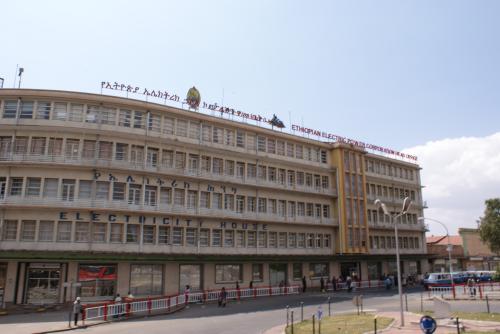
Actual photo of the Italian-era building of the Ethiopian Electricity company, built in the early 1940s in typical modern Italian style.
Italians even created and enlarged new airports and in 1936 started the worldwide famous "Linea dell'Impero", a flight connecting Addis Abeba to Rome (http://www.timetableimages.com/ttimages/ala38af.htm ). The line was opened after the Italian conquest of Ethiopia and was followed by the first air links with the Italian colonies in Africa Orientale Italiana (Italian East Africa), which began in a pioneering way since 1934. The route was enlarged to 6,379 km and initially joined Rome with Addis Ababa via Syracuse, Benghazi, Cairo, Wadi Halfa, Khartoum, Kassala, Asmara, Dire Dawa .
There was a change of aircraft in Benghazi (or sometimes in Tripoli). The route was carried out in three and a half days of daytime flight and the frequency was four flights per week in both directions. Later from Addis Ababa there were three flights a week that continued to Mogadishu, capital of Italian Somalia.
 The railway Addis Abeba-Djibouti was defended from guerrilla attacks by special military units until 1938, when the route was declared safe and "pacified".
There was a change of aircraft in Benghazi (or sometimes in Tripoli). The route was carried out in three and a half days of daytime flight and the frequency was four flights per week in both directions. Later from Addis Ababa there were three flights a week that continued to Mogadishu, capital of Italian Somalia.

The most important railway line in the African colonies of the Kingdom of Italy, the Djibouti-Addis Ababa long 784 km, was acquired following the conquest of the Ethiopian Empire by the Italians in 1936. The route was served until 1935 by steam trains that took about 36 hours to do the total trip between the capital of Ethiopia and the port of Djibouti. Following the Italian conquest was obtained in 1938 the increase of speed for the trains with the introduction of four railcars high capacity "type 038" derived from the model Fiat ALn56 (http://www.train-franco-ethiopien.com/photos_cfe/autorails_fiat_cfe/pages/image/imagepage15.html ).
These diesel trains were able to reach 70 km/h and so the time travel was cut in half to just 18 hours: they were used until the mid 1960s (http://www.train-franco-ethiopien.com/photos_cfe/autorails_fiat_cfe/pages/image/imagepage30.html ). At the main stations there were some bus connections to the other cities of Italian Ethiopia not served by the railway (http://www.train-franco-ethiopien.com/photos_cfe/gare_diredawa_cfe/pages/image/imagepage15.html ).
Additionally, near the Addis Ababa station was created a special unit against fire, that was the only one in all Africa. The route of the railway was protected by special military units until 1938, when the Ethiopian guerrilla finished and all the regions crossed by the trains were fully "pacified".
Additionally, near the Addis Ababa station was created a special unit against fire, that was the only one in all Africa. The route of the railway was protected by special military units until 1938, when the Ethiopian guerrilla finished and all the regions crossed by the trains were fully "pacified".
However Ethiopia and Africa Orientale Italiana (AOI) proved to be extremely expensive to maintain, as the budget for the fiscal year 1936-37 had been set at 19.136 billion lire to create the necessary infrastructure for the colony.[15] At the time, Italy's entire yearly revenue was only 18.581 billion lire (https://storicamente.org/gagliardi_colonie_italiane_africa_fascismo ).
ARCHITECTURE
Cinemas & Theaters
Cinemas & Theaters
The first Italian cinema in Addis Abeba was the "Romano", opened in October 1936 , followed by the "Marconi" in via Tripoli. The "Cinque Maggio" and the "Italia" cine-theater of the 'House of the Fascist Hospitality' were inaugurated both in 1937. The "Italia" was a super cinema with 1200 seats.
Late 1939 photo of the cinema "Impero"
 The "Impero" in via Massaia and the "Rome" were built later, just before WW2 started.
In 1939, the new "Marconi" cinema-theater was designed by Ippolito Battaglia.
The cinema showed the same morphology of the elements used in the project of the building for the government offices (prepared in the same years by architect Plinio Marconi for the monumental area of the city).
The "Impero" in via Massaia and the "Rome" were built later, just before WW2 started.
In 1939, the new "Marconi" cinema-theater was designed by Ippolito Battaglia.
The cinema showed the same morphology of the elements used in the project of the building for the government offices (prepared in the same years by architect Plinio Marconi for the monumental area of the city).

Hospitals
In Addis Ababa, at the time of taking possession of the city, were recovered and restructured by the Italian government some of the existing health facilities: the Ospedale Italiano/Italian Hospital "Principessa di Piemonte" (built by the "Italica Gens" - A.N.M.I.), the Hospital "Duca degli Abruzzi" (only for Italians) and the Hospital "Vittorio Emanuele III" (only for indigenous Ethiopians).
 The Italian hospital, showed a "classicism" shape with clad in light yellow trachyte stone and decorated by red brick; it was built from 1931 to 1934 on a project by engineer Piero Molli from Turin and it was among the first three-story buildings of the city, built with reinforced concrete frames. The engineer of the works was Mario Bayon, while the structural calculations were performed by the engineer Giberti. In October 1939, an additional expansion was studied.

Schools
*Scuola elementare mista Vittorio Emanuele III of Addis Abéba.
*Ginnasio-Liceo Vittorio Emanuele III
*Istituto tecnico Benito Mussolini
*Missione della consolata (asilo d infanzia e scuola elementare parificata mista).
*Scuola parificata mista del Littorio. Missione delle suore canossiane (scuola parificata, a Cabanà). Missione San Vincenzo da Paola (scuola governativa per tracomatosi).
*Missione della Consolata (scuola parificata, brefotrofio per bambine, orfanotrofio).
*Missione della Consolata (college for the sons of Ethiopian authorities, under the "Direzione superiore affari politici").
*School for muslims
Photo of Italian colonists in a 1939 folklorist meeting in the Addis Abeba outskirts, celebrating with Italian regional dances. Viceroy Amedeo D'Aosta planned to bring 20,000 Italian colonists in 1942 to live in the Scioa region, imitating what was done in Libya with the 20,000 colonists who successfully settled there in 1938. Mussolini by 1956 (in order to commemorate twenty years of the Italian empire existence) wanted to move half a million Italians to live in the Ethiopian Highlands, but WW2 blocked all these projects

Associations
* Sopraintendenza scolastica.
*Casa del fascio.
*Istituto di cultura fascista. Opera nazionale dopolavoro.
*Gioventù italiana del littorio.
*Fascist university group. The Gioventu Universitaria Fascista (GUF) of Addis Ababa, made up of volunteers from the Ethiopian war and directed by Fabio Roversi Monaco, played an important role in the promotion of cultural activities in the empire. The preparation of prelates and assistance to graduates for enrollment in Italian faculties were also fundamental. In 1939 the GUF asked the government to evaluate the possible creation of a university of the empire or, at least, to allow the exams to take place directly in Addis Abeba.
*Ufficio stampa e propaganda AOI.
*Casa dei giornalisti.
*Ufficio superiore cartografico.
*Museo dell impero.
*Opera nazionale combattenti.
*Regio automobile club d Italia.
*Consociazione turistica italiana; Compagnia italiana turismo cinema, teatri, radio.
* Istituto luce Impero Italiano
*Cinema teatro Italia (Casa dell ospitalità fascista)
*Cinema Impero
*Cinema Romano
*Cinema Cinque maggio (for native ethiopians)
* Stazione radiofonica Eiar (with auditorium) of the Istituto Luce (Ethiopia).
Newspapers and magazines
*«Corriere dell Impero» newspaper (called "Quotidiano di Addis Abeba" from March 1938 until February 1938 as journal of the "Federazione dei fasci di combattimento"; from May to December 1936 called «Il Giornale di Addis Abeba»)
*«Il Lunedì dell Impero» (magazine of the «Corriere dell Impero»)
*«Marciare» («Magazine of "Goliardia fascista dell Impero". Giornale mensile di avanguardia del Guf»)
*«Ye Chessar Menghist Melchtegnà» («Corriere dell Impero» in Ethiopian language). Weekly magazine published by the «Barid al-imbiraturiyyah»
*«Il messaggero dell Impero»; weekly newspaper in arab language published by the " Ufficio stampa e propaganda"; from March to December1938 «Kuriri di Imbiru»( inside the «Corriere dell Impero])
*«Ye Roma Berhan» («Luce di Roma»).Monthly magazine in Aramaic language.
*«Addis Abeba» (monthly magazine of the Addis Abeba city hall)
*«Etiopia Latina» (monthly magazine)
*«L Impero illustrato» (weekly magazine); «Notiziario mensile della MVSN nell AOI»; «L Impero del Lavoro» (magazine of the "Ispettorato fascista del lavoro")
*«Rassegna sanitaria dell AOI» (weekly magazine published by the "Società di medicina dell impero")
*«La Consolata in AOI» (monthly magazine of the "Missione della Consolata editori "
*Tipografia del Governo; Generale Stamperia del Littorio
*Tipografia della missione della Consolata
*Bulletins/Journals: Giornale ufficiale del governo Generale dell Africa Orientale Italiana e Bollettino ufficiale del Governo dello Scioa» (weekly); «Foglio d ordini e di comunicazioni del Governo Generale dell Africa Orientale Italiana» (monthly) ; «Foglio d ordini dello Stato Maggiore del Governo Generale dell Africa Orientale Italiana» (monthly) ; «Foglio d ordini e di comunicazioni del Governo dello Scioa» (monthly) ; «Bollettino dell Ufficio dell Economia Corporativa dello Scioa» (monthly); «Bollettino dell Economia Corporativa dello Scioa» (monthly) «Scioa» (monthly published by the "Ufficio della produzione e del lavoro"); «Bollettino di idrobiologia, caccia e pesca dell Africa Orientale Italiana» (news from the "Servizio di idrobiologia e pesca e della Sovrintendenza alla caccia"
LINKS
* http://senato.archivioluce.it/senato-luce/ricerca/libera/esito.html?query=addis+abeba Photos of Italian Addis Abeba


